Nace AI Releases Drex for Search for AI Agents: 92.05% on BrowseComp-Plus With 12.6 Search Calls
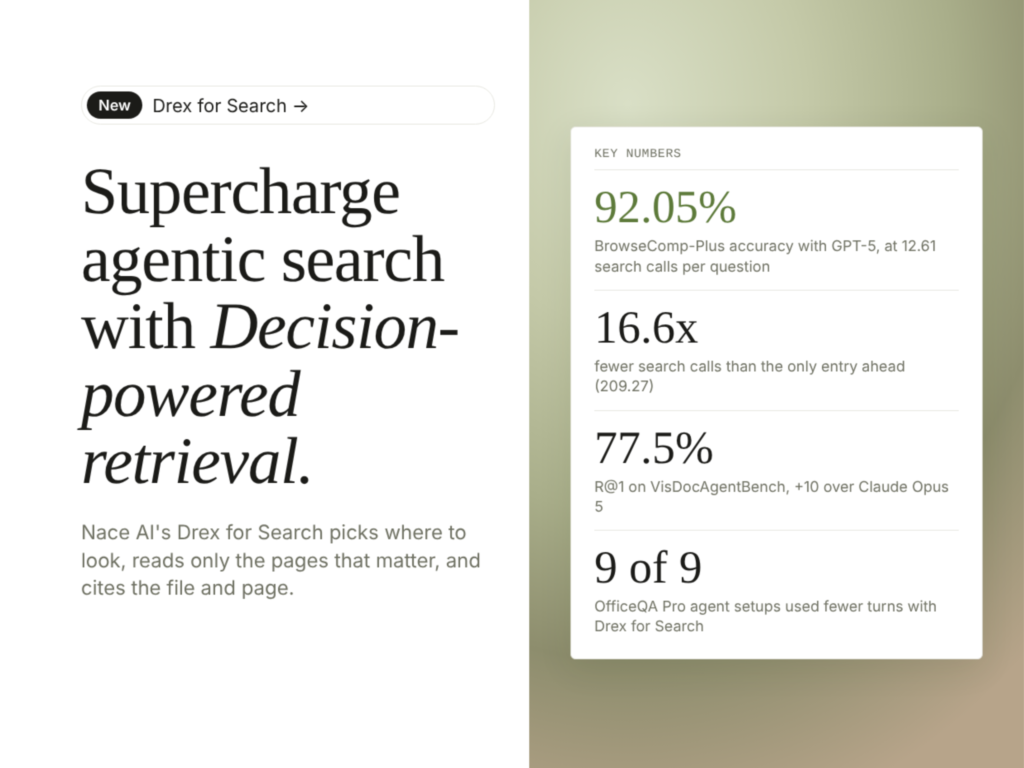
Nace AI has released Drex for Search, which brings its Drex decision models to document search. Drex for Search is a retrieval layer that helps people and agents find evidence. Coding agents such as Claude Code, Codex, Cursor and OpenCode call it through CLI, SDKs, MCP or REST. In Nace’s evaluation, it scores 92.05% on BrowseComp-Plus with GPT-5, using 12.6 search calls per question.
What did Nace AI release?
Nace AI frames search as a series of decisions. Drex for Search applies its Drex models to those decisions. Drex scores given options with a calibrated probability each, in 1 forward pass. That makes it cheap enough for every agent step.
The release targets classic RAG, which Nace sums up as chunk, embed, top-k, hope.
The pipeline breaks in 3 cases:
the answer sits in a table on page 23
the answer needs 2 hops across files
the answer is inside a scanned PDF
How does Drex for Search work inside an agent?
Nace describes 3 steps:
Classify: Before any search runs, Drex decides if the question needs a quick lookup or an agent. The agent route reads documents and queries tables.
Squeeze: Drex walks the workspace level by level: folder, file, section, page. Inside a sheet, it narrows to table and column. Each level keeps only what can hold the answer.
Answer: Only the kept pages and tables reach the LLM. The answer cites the file and page.
Depth is fixed, so Nace says a million files take as many steps as a thousand.
How much does it help coding agents?
Nace AI tested 9 agent and model pairs on OfficeQA Pro, a 133-question benchmark over U.S. Treasury Bulletins. Key highlights: 6% more answers right, 62% fewer steps, 56% fewer tokens, and 2.3x faster.
What does a workspace include?
Files: PDFs and scans, xlsx, csv and Parquet, mp3 and mp4, docx, pptx, md, json and txt.
Citations: every answer names the file and the page, row or minute it came from.
Workspaces: isolated, with their own index and knowledge graph, and shareable with invited members.
Storage: upload files or folders, or keep workspaces in your own S3 bucket or Azure Blob container.
Zero retention: available with your own storage.
Domains: Tax, M&A, SEC 10-K, Contracts, or your own.
How does it perform on BrowseComp-Plus?
BrowseComp-Plus asks a deep-research agent 830 multi-hop questions over about 100K fixed web documents. With GPT-5, Nace AI reports:
92.05% accuracy, #2 of 86 entries on the leaderboard.
12.61 search calls per question, 16.6x fewer than the only entry ahead (209.27 calls).
87.32% in a single pass with 8.93 search calls, the best of any entry under 10 calls.
+20.4 points over the Qwen3-Embed-8B baseline, with the same GPT-5 model.
How does it score on document benchmarks?
On VisDocAgentBench, an agent finds 1 target page among 2,375 arXiv pages. Drex for Search scores 77.5% R@1 with an open-weight Qwen 27B planner. The best published agent, Claude Opus 5, scores 67.5%. R@1 is 97.5% on direct questions, 77.5% on one bridge, and 57.5% on two.
On MADQA, agents answer over 800 PDFs and cite pages. Nace reports 94.7% accuracy with Gemini 3.5 Flash and a page-attribution F1 of 88.2. Its effort calibration (Kuiper) is 6.66. Nace ranks it #1, based on the leaderboard as read on October 20. With open-weight Qwen 27B, Nace reports 93.4%.
On EnterpriseRAG-Bench, with 500,000+ internal company documents, Nace reports an overall score of 88.22, which it ranks #3. That is 27.2 points above OpenAI File Search (61.03).
How does it compare with the best published results?
Ranks and scores are as published by Nace AI, from leaderboards read October 20, 2026.
How can developers get access?
Drex for Search runs in the Nace API Console, with 4 ways in on one key:
Check out the Drex for Search page, API Console, Docs and Hugging Face.
Thanks to the Nace AI team for the thought leadership / resources for this article. This article is sponsored by Nace AI.
Asif Razzaq is the CEO of Marktechpost AI Media Inc.. As a visionary entrepreneur and engineer, Asif is committed to harnessing the potential of Artificial Intelligence for social good. His most recent endeavor is the launch of an Artificial Intelligence Media Platform, Marktechpost, which stands out for its in-depth coverage of machine learning and deep learning news that is both technically sound and easily understandable by a wide audience. The platform boasts of over 2 million monthly views, illustrating its popularity among audiences.
Originally published by marktechpost.com →