Microsoft Open-Sources Agensh: A Multi-Agent Harness for 1,024 Agents
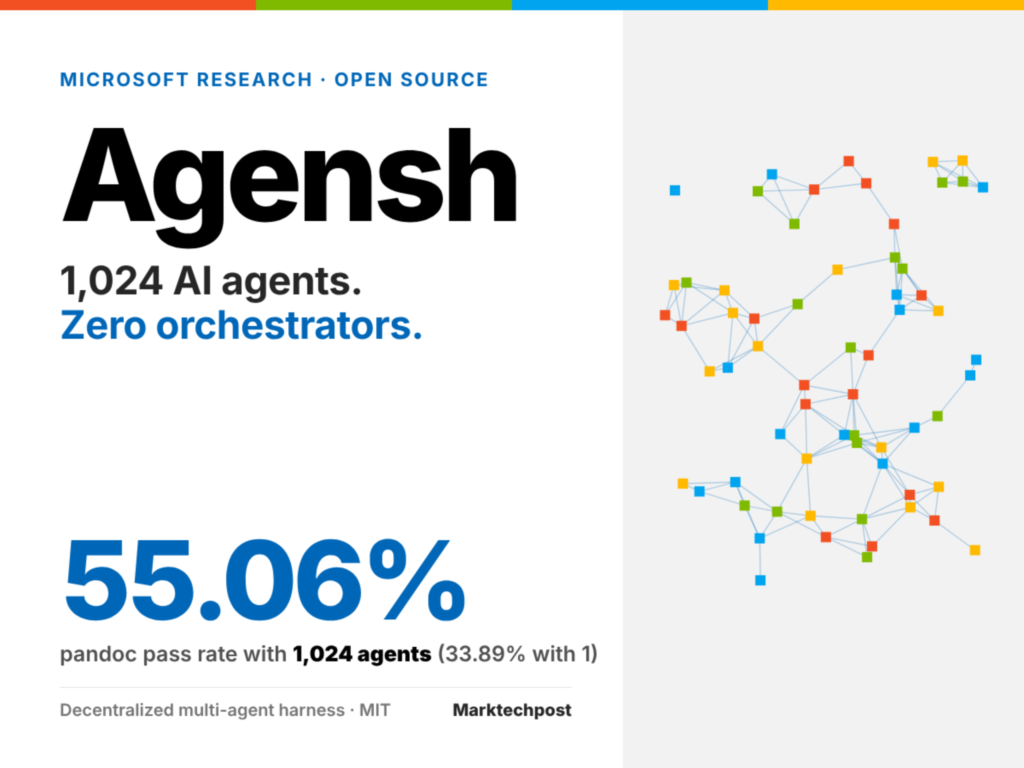
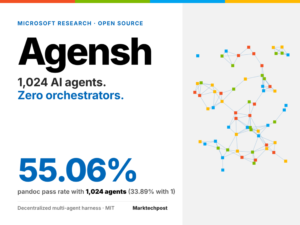
Microsoft Research has open-sourced Agensh, a decentralized harness for large teams of coding agents. The Agensh multi-agent harness removes the central orchestrator that most agent frameworks depend on. Every worker picks its own sub-task, shares findings and merges code into a common Git repo. On ProgramBench, the team scaled the setup from 1 agent to 1,024 agents.
What is Agensh?
Agensh is a multi-agent harness from Microsoft Research that coordinates many LLM agents without a lead agent.
The target problem is the orchestrator ceiling. In orchestrator-worker designs, a lead agent plans, assigns and merges all work. The research paper cites Claude Code agent teams, Codex sub-agents, Copilot fleet and Kimi Agent Swarm as examples. Agensh lets the workers do that coordination themselves.
How does the Agensh cooperation loop work?
Each worker runs the same 5-step loop, concurrently and asynchronously:
Gather context: read the goal, peer progress, messages and findings.
Claim a sub-task: post a CLAIM, then settle overlaps by direct message.
Take action: work locally with tools and post useful findings early.
Verify results: check the work against the sub-task’s acceptance criteria.
Merge progress: merge into the shared repo, post an update, then repeat.
Three services connect the workers. Gitea hosts the shared workspace, with branches, PRs and merge conflicts. Mattermost carries a team channel plus direct messages for urgent collisions. A shared context board, adapted from DeLM, stores typed notes: OBSERVED, FACT, FAIL, CLAIM and PATCH_SUMMARY.
The loop lives in the prompt, not in runtime code. Every worker gets the same prompt except its ID. Agensh sits on top of a single-agent harness. The experiments used GitHub Copilot CLI. The research paper states thin adapters can connect other harnesses, such as Claude Code.
How well does Agensh scale on ProgramBench?
Microsoft team tested the 5 hardest ProgramBench tasks: FFmpeg, gromacs, pandoc, PHP-src and ctags. Agents rebuild each program from its observed behavior. They work offline, within 6 hours. Reference repos range from 2,767 files (pandoc) to 26,266 files (PHP-src).
With GPT-5.6-sol at high reasoning effort, the mean final test-pass rate moved as follows:
1 agent: 19.31%
8 agents: 20.68%
32 agents: 26.52%
128 agents: 28.78%
That is a 9.47-point gain, about 49% relative. On pandoc alone, scores were 33.89% (1), 41.75% (8), 43.11% (32), 50.94% (128) and 55.06% (1,024).
Speed improved too: on pandoc, 128 agents passed 30% at the 30-minute checkpoint. 32 and 8 agents needed 60 and 90 minutes.
The README adds a newer model. With GPT-6.1-sol, pandoc rose from 56.19% (1 agent) to 79.59% (32 agents). That is a 41.64% relative gain. These GPT-6.1-sol figures are not in the v1 paper.
What behaviors emerged as the team grew?
The research team traced worker trajectories at each scale:
8 agents: peers agreed on interfaces and resolved overlapping claims themselves.
32 agents: peers reviewed shared work; one approval was withdrawn after a counterexample.
128 agents: workers reused trusted reviewers and standardized an integration protocol.
1,024 agents: several workers acted as integrators, and peers recovered failed work.
None of these roles was hard-coded.
How does Agensh compare with other multi-agent harnesses?
How do you run Agensh?
The release includes a single-node Docker Compose team and a single-agent baseline. Both use native Copilot ACP sessions. You need Linux with Docker Engine, Compose v2, systemd, cgroup v2 and Python 3.11+. Defaults are 8 workers, 6 hours per task and gpt-5.6-sol at high effort. You also need ProgramBench (v1.2.5 was validated) and a model API token. Full steps sit in the reproduction guide.
Check out the Paper, GitHub Repo and Project Page. Also, feel free to follow us on Twitter and don’t forget to join our 150k+ML SubReddit and Subscribe to our Newsletter. Wait! are you on telegram? now you can join us on telegram as well.
Need to partner with us for promoting your GitHub Repo OR Hugging Face Page OR Product Release OR Webinar etc.? Connect with us
Asif Razzaq is the CEO of Marktechpost AI Media Inc.. As a visionary entrepreneur and engineer, Asif is committed to harnessing the potential of Artificial Intelligence for social good. His most recent endeavor is the launch of an Artificial Intelligence Media Platform, Marktechpost, which stands out for its in-depth coverage of machine learning and deep learning news that is both technically sound and easily understandable by a wide audience. The platform boasts of over 2 million monthly views, illustrating its popularity among audiences.
Originally published by marktechpost.com →