Z AI Releases GLM-5.4: A 750B Loop Transformer That Runs 28 Layers Twice
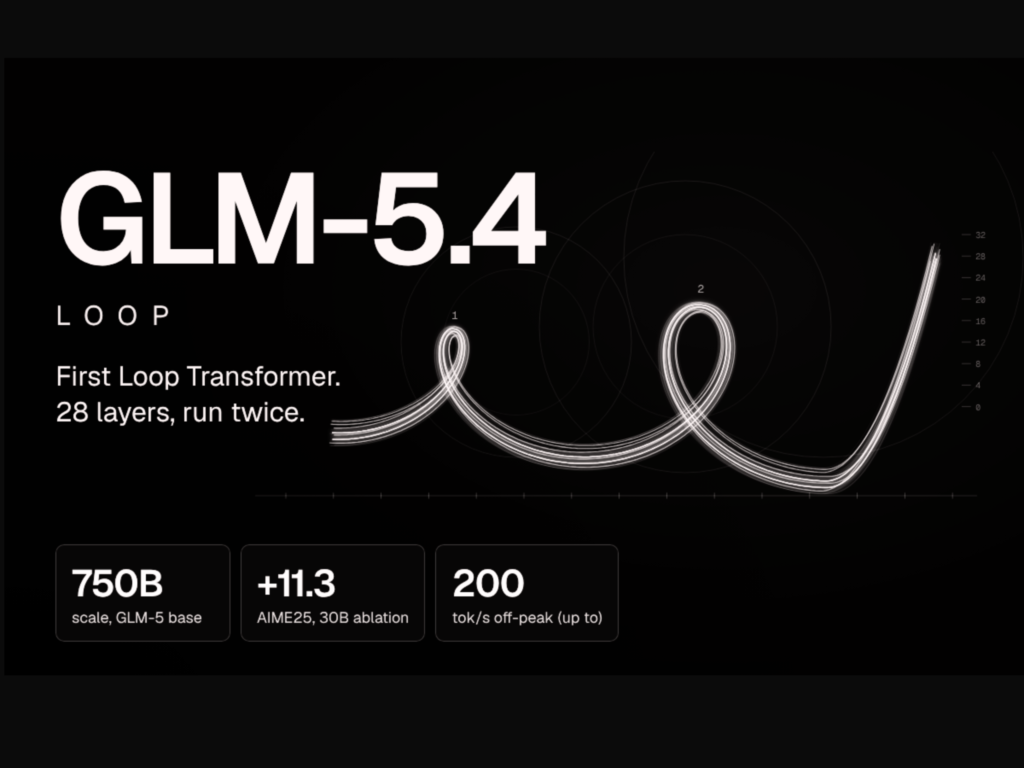
Z.ai has released GLM-5.4, its first flagship model built on a Loop Transformer architecture. The GLM-5.4 Loop Transformer runs 28 layers of the GLM-5 base model for 2 iterations. Z.ai says the model reaches intelligence comparable to 2T-3T parameter models. For developers, the pitch is ‘Generalized Coding’: code as the tool for video, games, 3D shaders and CAD.
What is GLM-5.4?
GLM-5.4 is a 750B-scale Loop Transformer from Z.ai that runs shared layers twice per pass. It ships first inside Z.ai’s own products: the GLM Coding Plan, the ZCode desktop app and Z.ai Chat.
Z.ai did not pre-train a looped model from scratch. It adapted the pre-trained GLM-5 base through continued training. The technical post states that looped models trained from scratch still trail unshared models at equal compute. Adapting an existing base raises the ceiling with a relatively small compute overhead.
How does the Loop Transformer work?
In a standard Transformer, each layer runs once per forward pass. In GLM-5.4, a group of 28 weight-shared layers runs for 2 iterations. Z.ai made 3 changes to keep this practical at 750B scale.
Gated progressive updates
Overwriting hidden states across loops made activation norms blow up. GLM-5.4 adds independent per-token gates for each iteration. The first pass writes small updates and builds global context. The second pass opens the gates to refine the output. On harder tokens, the first pass writes more aggressively.
Hybrid KV cache
A naive design keeps a full KV cache for every loop. GLM-5.4’s second loop reuses the sparse KV selected in pass 1. It keeps its own new KV only inside a local sliding window. So the extra loop costs 1 sliding window of KV cache, not a full context cache. Z.ai says this keeps the cost increase over GLM-5.3 under control at 1M context.
Sparse attention index reuse
The second loop reuses the indices from the first loop’s indexer. That adds zero indexing overhead. Z.ai reports near-identical results versus recomputing indices on every pass.
How does GLM-5.4 perform on benchmarks?
Z.ai has not published benchmark scores for the 750B GLM-5.4 model. A Z.ai team member said scores will come later, per DataCamp. The evidence in the blog is an iso-parameter ablation on a 30B model. It shares the 750B base’s architecture. The looped version used about 10% more total training compute. Scores were measured after 200K long-context SFT with thinking mode on.
Source: Z.ai GLM-5.4 blog. Self-reported, 30B model, not the 750B flagship.
Two patterns stand out. The largest gains come in math, science reasoning and long context. Output length also falls on most tasks. MMLU-Pro answers got 14.9% shorter and GPQA-Diamond answers 11.7% shorter. Z.ai says part of the reasoning moves into the loop’s implicit depth. AIME25 is the exception: output length dropped only 2%.
Z.ai validated the design on 1B, 4B, 30B and 750B bases. The ‘2T-3T parameter’ claim has no flagship table behind it yet.
What can GLM-5.4 do beyond traditional coding?
Z.ai calls this direction Generalized Coding. It credits gains in both coding and vision. The technical sections shows four demos:
Video: a self-narrated music video called “Hello World”.
Engineering: a 6-axis robotic arm built through CAD modeling in FreeCAD.
Games: a complete game with movement, physics, maps, combat and art assets.
3D: an interactive bird-watching scene built with math geometry and custom GLSL shaders.
These are vendor demos, not benchmarks.
How fast is GLM-5.4 and where can developers use it?
Z.ai reports up to 200 tokens/s off-peak and 70-80 tokens/s at peak load. It fused core kernels to cut intermediate memory traffic.
Access today runs through the GLM Coding Plan, ZCode and Z.ai Chat. ZCode is Z.ai’s desktop agent harness for GLM-5.4. It runs on macOS, Windows and Linux (Beta). The Coding Plan lists Lite at $12.6/month, Pro at $56 and Max at $117.6. Z.ai says prices may change.
How does GLM-5.4 compare with other open frontier models?
Check out the official GLM-5.4 tech blog and try it in ZCode. You can check the deployment options and specs here through our GPULeaderboard.com chrome extension.
Also, feel free to follow us on Twitter and don’t forget to join our 150k+ML SubReddit and Subscribe to our Newsletter. Wait! are you on telegram? now you can join us on telegram as well.
Need to partner with us for promoting your GitHub Repo OR Hugging Face Page OR Product Release OR Webinar etc.? Connect with us
Asif Razzaq is the CEO of Marktechpost AI Media Inc.. As a visionary entrepreneur and engineer, Asif is committed to harnessing the potential of Artificial Intelligence for social good. His most recent endeavor is the launch of an Artificial Intelligence Media Platform, Marktechpost, which stands out for its in-depth coverage of machine learning and deep learning news that is both technically sound and easily understandable by a wide audience. The platform boasts of over 2 million monthly views, illustrating its popularity among audiences.
Originally published by marktechpost.com →