Saylor Boasts 34% Annual MSTR Returns While Strategy Sits $12B Underwater
Saylor’s Scorecard
Despite the bearish mood pervading the market, Saylor took to social media in the hopes of boosting sentiment. He wrote:
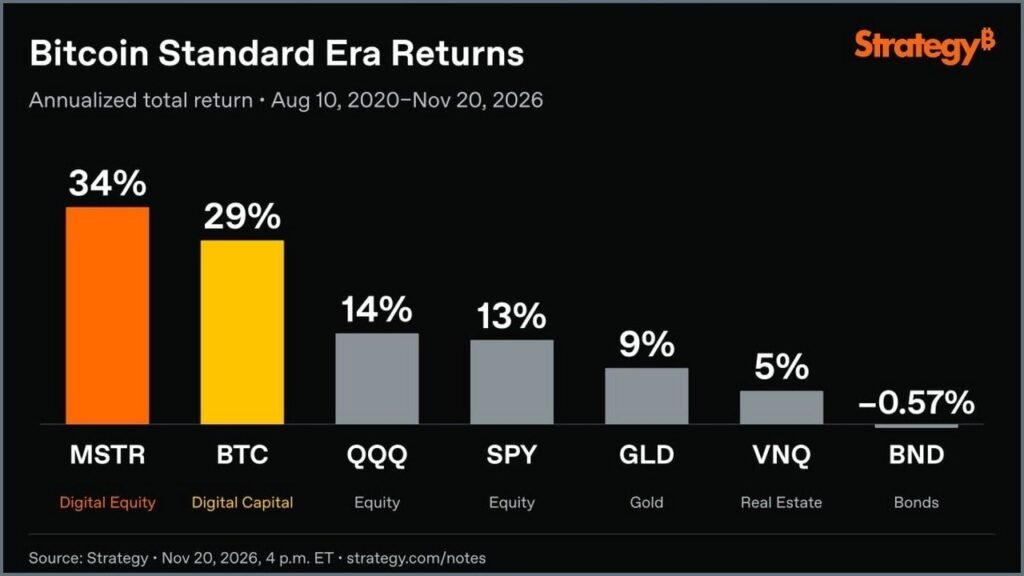
Digital Equity builds on Digital Capital. During the Bitcoin Standard Era, MSTR delivered 34% annualized returns, outperforming Bitcoin and the traditional asset benchmarks shown.
The commentary followed an earlier chart in which Saylor argued that Digital Capital outperformed equity, metals, real estate and debt over the same period. The “Bitcoin Standard Era” refers to the stretch since August 2020, when the company, then known as Microstrategy, began converting its treasury into bitcoin. Subsequently, earlier today, Saylor added a third message:
Strategy engineers volatility to create a spectrum of financial products for equity, derivatives, commodity, and credit investors.
Examining Saylor’s Numbers
The long-term view, however, comes at an eerily painful moment, especially since Strategy’s Nov. 16 filing shows that the company holds 850,849 BTC acquired for $64.20 billion (at an average of $75,452 per coin). It added just 485 BTC the prior week at an average of $68,887, funded through MSTR stock sales.
With bitcoin trading near $61,200, those holdings are worth about $51.6 billion, roughly $12.6 billion, or 19.6%, below cost. As a result, the stock has taken the hit too, with MSTR closing at $77.80 on Friday, down from $122.35 on Nov. 11 (a 36% slide in seven sessions).
Bitcoin.com News reported that shares had hit a 21-month low as Blockstream CEO Adam Back bought the dip, and one analyst warned the stock could drop 75% to $23 if a bearish pattern holds.
In sum, Saylor’s 34% figure is a long-horizon number meant to reflect gains built up over six years (most of which were earned well before this month’s drawdown).
Lastly, long-run averages hide how volatile the ride has been, as MSTR has repeatedly swung 50% or more in both directions, which is exactly the volatility Saylor now pitches as a feature rather than a flaw.
Critics Are Not Buying It
Skeptics have seized on the decline, and gold advocate Peter Schiff last week called Strategy a “complete fraud” as bitcoin sank. The company has also been defending its STRC preferred stock, with Saylor saying Strategy could shrink STRC to $5 billion and even sell bitcoin to support it.
Supporters see the drawdown as an opportunity, with many quoting Saylor’s Sunday “The dots aren’t done” post with “Saylor’s Strategy bought! Everyone should stack cheap Bitcoin.” No purchase had been filed with the SEC as of early Monday UTC.
Monday’s 8-K Is the Next Real Test
Saylor’s Sunday tracker posts have typically come before a Monday 8-K disclosing the prior week’s buys and Bitcoin.com News reported yesterday that Saylor had hinted at another purchase. Any buy made between Nov. 16 and Nov. 22 would land well below the company’s $75,452 average, lowering its cost basis slightly.
The bigger question is funding, given Strategy has been leaning on MSTR stock sales, and selling shares near $78 dilutes existing holders far more than issuing them above $120 did two weeks ago. How much bitcoin the next filing shows, and how it was paid for, will tell investors whether Saylor’s 34% pitch is attracting fresh capital or simply reminding holders of better days.


Originally published by news.bitcoin.com →