UAE-Led Global Operation Traces More Than $39 Billion in Scam-Linked Funds and Crypto, Leading to 960+ Arrests
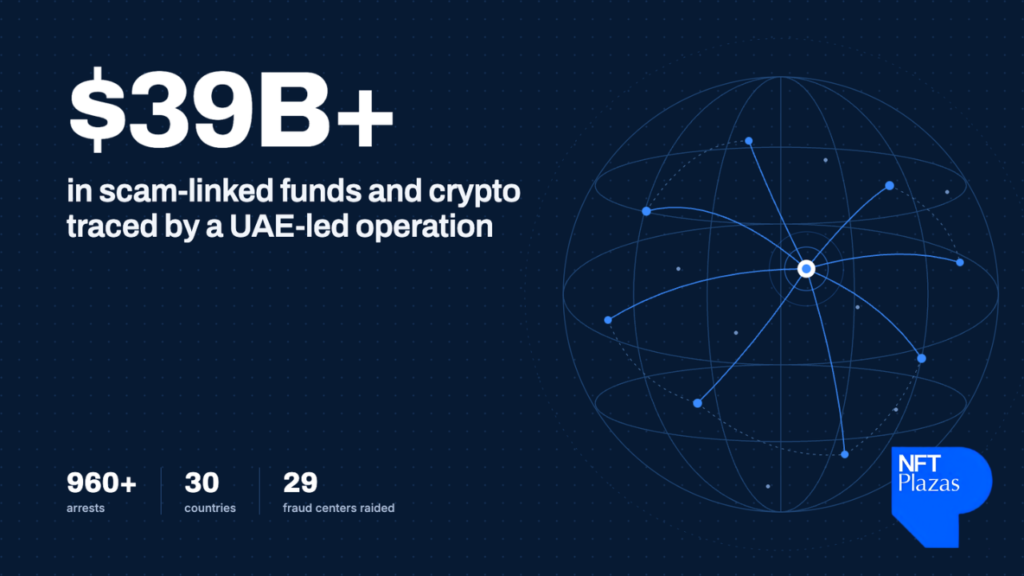
A three-month international crackdown led by the United Arab Emirates has traced more than $39 billion in funds and cryptocurrencies tied to scam activity and led to more than 960 arrests, the UAE Ministry of Interior announced on October 22.
The initiative, called Operation Confrontation Ghost, brought together law enforcement agencies from 30 countries, along with INTERPOL, the Global Anti-Scam Alliance (GASA) and 13 companies from the technology and financial sectors. It ran from July 1 to September 30, 2026, and targeted three fast-growing categories of crime: AI-enabled fraud, digital financial fraud and technology-facilitated sextortion.
The results were presented in Vienna at a UAE-hosted side event during the 13th session of the Conference of the Parties to the United Nations Convention against Transnational Organized Crime (UNTOC COP13).
A Wide Net Across Five Continents
According to the ministry, investigators identified more than 15,500 victims and over 3,500 suspects. Authorities raided 29 fraud centers, shut down more than 570 social media accounts used to manipulate victims and move money, and flagged 4,126 bank accounts connected to fraud.
Participating agencies exchanged more than 9,000 pieces of intelligence over the three months, which officials said helped them identify suspects, map how scam networks operate and follow illicit money across borders. Investigators also documented distinct criminal methods, building a shared picture of how fraud groups recruit and deceive victims and launder the proceeds.
The participating countries included the UAE, the United Kingdom, Canada, Japan, China, France, the Netherlands, Singapore, the Philippines, Myanmar, Indonesia, the Republic of Korea, Brazil, Kenya, Senegal and Morocco, among others. The ministry did not provide a country-by-country breakdown of arrests or disclose where the 29 raided centers were located.
Private Sector Plays a Central Role
A defining feature of the operation was the involvement of companies whose platforms and payment systems are often exploited by scammers. The 13 partners were Bayut, Crypto.com, Dubizzle, Feedzai, Ghostly Solutions, Group-IB, Huawei, Mastercard, Meiya Pico, Meta, Outseer, TikTok and Trend Micro.
The mix reflects how fraud now moves through many channels at once. Social media and video platforms are often used to make first contact with victims, online marketplaces can serve as bait, and payment networks and crypto exchanges allow money to move quickly between jurisdictions. Cybersecurity and fraud-detection firms supply the tools needed to trace those flows.
Colonel Dana Humaid Al Marzouqi, Director General of the International Affairs Bureau at the UAE Ministry of Interior, said the operation turned shared intelligence into coordinated action. She described it as a first-of-its-kind initiative showing how the UAE is driving practical international responses to AI-enabled fraud and cross-border scams.
Identified, Not Yet Recovered
The headline figure comes with an important caveat. The $39 billion represents funds and digital assets that investigators identified as linked to scams, not money that has been seized or returned to victims.
The ministry said participating countries, jurisdictions and private-sector partners are working toward recovering the assets, but did not say how much has been recovered so far. It also did not specify what share of the total is held in cryptocurrency.
That distinction matters when comparing the operation with other recent enforcement efforts. INTERPOL’s Operation Serengeti III, which ran from late June through August 2026 across 20 African countries and the United States, reported 1,462 arrests and more than $105 million in illicit funds recovered. Separately, the FBI said on October 13 that its global Operation Blackout had seized roughly $17 billion in assets and crypto.
Because these operations measure different things, and because it is unclear whether their totals overlap, the figures should not be combined or compared directly.

Sextortion and AI Fraud in Focus
The operation’s attention to technology-facilitated sextortion highlights a crime of growing concern worldwide. Officials noted that it often targets children and teenagers, leaving lasting harm for victims and their families.
AI-enabled fraud was another priority. Criminal groups increasingly use artificial intelligence to create convincing fake identities, voices and messages, making scams harder to detect and easier to run at scale.
UN Recognition
The United Nations Office on Drugs and Crime (UNODC) praised the operation, recognizing the UAE’s role in bringing law enforcement, financial institutions and technology companies together under a single framework.
Speaking at the event, UNODC Executive Director Monica Juma commended the UAE for using its convening power to make the operation possible and acknowledged the leadership of UAE President Sheikh Mohamed bin Zayed Al Nahyan in advancing the effort.
The side event, titled “From Cooperation to Action: How Law Enforcement, International Organizations and the Private Sector Can Jointly Counter Organized Fraud,” focused on turning lessons from the operation into lasting cooperation and stronger public-private partnerships.
Looking Ahead
Scam networks have long exploited the gaps between national jurisdictions, operating in one country, targeting victims in another and moving money through a third. Operations like Confrontation Ghost aim to close those gaps by connecting investigators, platforms and financial institutions.
The biggest open question is how much of the $39 billion will ultimately be recovered. The ministry described asset recovery as ongoing and said it will keep working with international and private-sector partners to strengthen cooperation against transnational digital fraud.
Originally published by nftplazas.com →