Was AI Responsible for Finding the Coldcard Security Flaw?

A Coordinated Sweep Empties Hundreds of Wallets
The incident became public after roughly 594 BTC, valued near $38 million at the time, moved from about 500 single-signature bitcoin addresses on July 30. When the news first broke, Bitcoin.com News noted that the transfers occurred within approximately 25 minutes and appeared to target wallets with a shared technical weakness.
Later blockchain reviews expanded the possible scale of the theft. Researchers estimated that between 1,082 and 1,196 addresses may have been affected during a period of about 41 minutes. A custom dashboard called Coldcard Sweep Watch subsequently placed the total at 1,128.4717 BTC, worth about $71.1 million when bitcoin traded near $63,044.
Most of the funds were consolidated into an address holding hundreds of bitcoin, where a large portion remained largely stationary. The affected addresses were linked by one important detail: Their recovery seeds had been created on Coldcard hardware wallets manufactured by Canadian company Coinkite.
A recovery seed is a list of words that controls access to a cryptocurrency wallet. Anyone who can reconstruct or obtain that seed can usually move the wallet’s funds without possessing the physical device.
Coldcard Finds a Broken Randomness System
Coinkite issued an urgent advisory warning that certain seeds generated on Coldcard devices could be weak. Mk3 devices running firmware version 4.0.1, released around March 2021, and later versions were among those facing the greatest risk.
Further analysis widened the concern to seeds created on some Mk4, Mk5, and Q devices before Coinkite released emergency firmware fixes. Tapsigner, Opendime, and Satscard products were reportedly not affected because they use different software.
The flaw involved the process used to generate random data. Secure wallets depend on high-quality randomness so that their recovery seeds cannot be guessed. On the most seriously affected Mk3 devices, researchers estimated that the seed may have contained only about 40 bits of effective randomness instead of the intended 128 bits.
That difference is critical. A properly generated 128-bit seed is considered practically impossible to guess through brute force. A 40-bit seed offers dramatically fewer possibilities, allowing an attacker with enough computing power to test potential seeds offline and compare the resulting addresses with the public Bitcoin blockchain.
Some newer devices may have provided approximately 72 bits of effective randomness because secure hardware added another layer of unpredictable data. That would make the seeds harder to reconstruct, though still much weaker than intended.
One Configuration Error Survived for 5 Years
The problem began with a build-time configuration mistake involving two software functions that performed similar jobs. One function used the device’s hardware-based true random number generator, while the other relied on a weaker software process inherited from MicroPython.
Coinkite intended to disable the MicroPython option. However, a software check looked only at whether a configuration label had been defined, rather than whether its value had been set to zero. As a result, the finished firmware could silently select the weaker function.
Because the two functions had matching formats, the software continued to compile and run without producing an obvious error. The mistake entered the code around a 2021 software migration and remained in publicly available firmware for more than five years.
Updating a device now does not strengthen a seed that was generated under the faulty software. Affected users must create a completely new seed using corrected firmware or another secure device, then move their funds to addresses controlled by that new seed.
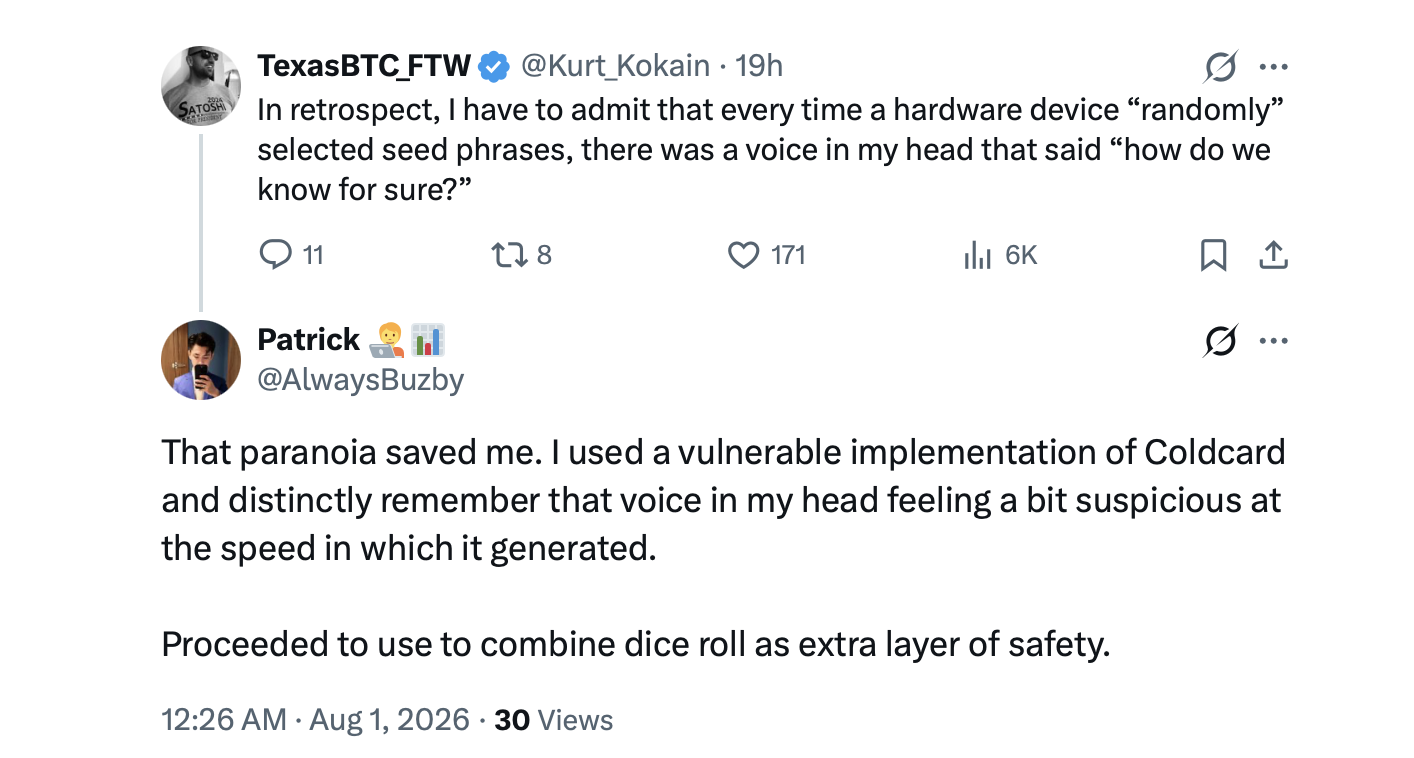
Users who added at least 50 independent dice rolls while creating their seed may have supplied enough extra randomness to avoid the weakness. A strong BIP-39 passphrase could also have made reconstruction more difficult, while wallets requiring signatures from several independent devices may have prevented one compromised seed from moving funds alone.
Coinkite Points to AI, but Proof Remains Missing
Coinkite CEO Rodolfo Novak apologized publicly and said the company took full responsibility for the firmware failure. He said the team was working on fixed software, technical reports, and support for affected users.
Coinkite and Novak also advanced a striking theory about how the flaw was discovered. Because its firmware had been publicly available for years, the company said it believed someone may have used AI to examine older versions of the code and locate the weak randomness path.
“To every other developer: we believe this is a sober reality of the new AI paradigm. AI-assisted code review can now find latent bugs at a speed that is outpacing even the industry’s most seasoned experts,” Novak wrote in his apology post published on X. “If your firmware is open-source or has ever been public, assume it’s already being read by attackers and defenders alike.”
Today’s modern AI coding systems can process large software repositories and identify suspicious relationships between configuration settings, functions, and security assumptions. An attacker could ask such a system to look specifically for weak random number generators, fallback functions, or errors affecting cryptographic keys.
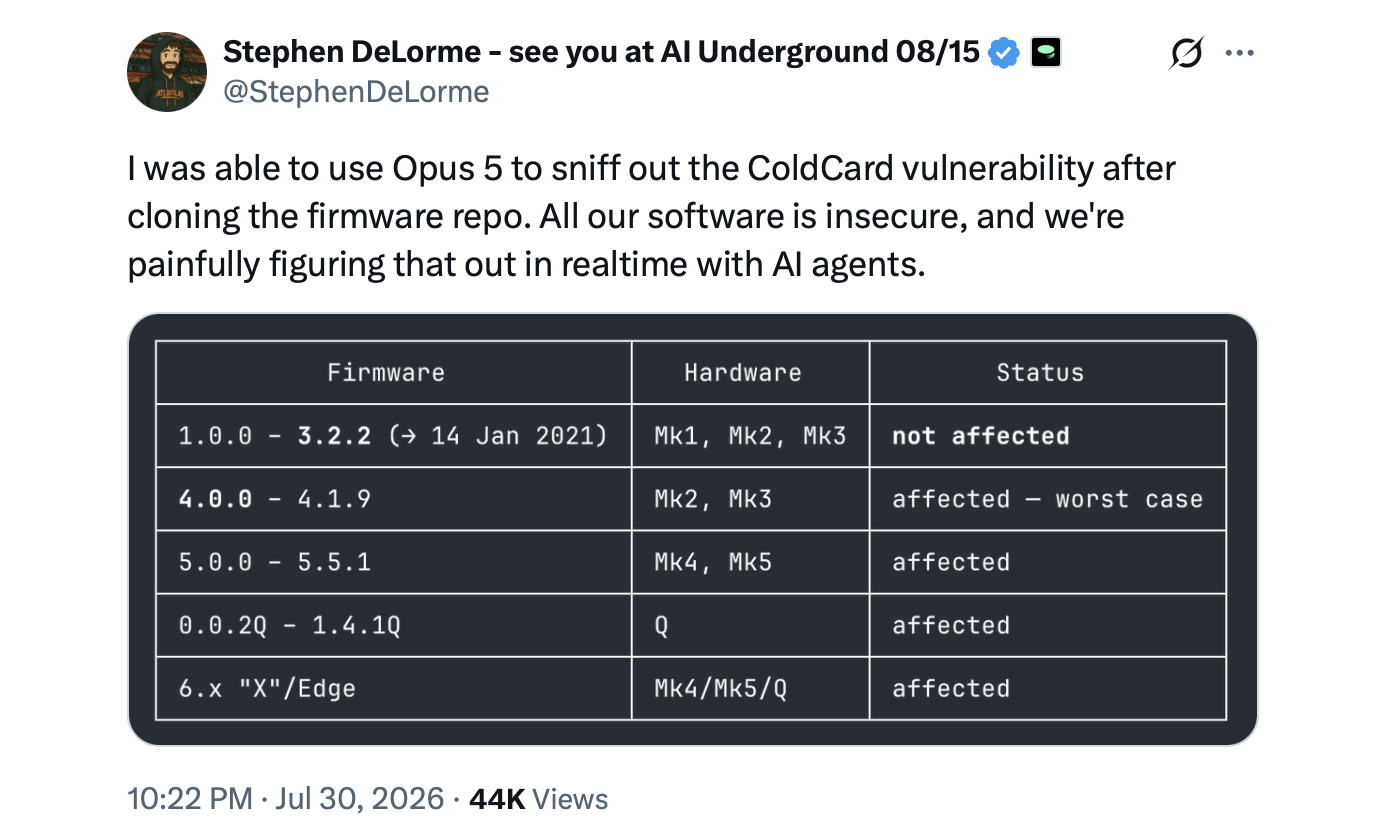
Independent researchers later reported using AI models to locate or explain the issue after the underlying randomness problem was known. That demonstrated how accessible AI-assisted code analysis has become, but it did not establish that the original attacker used AI.
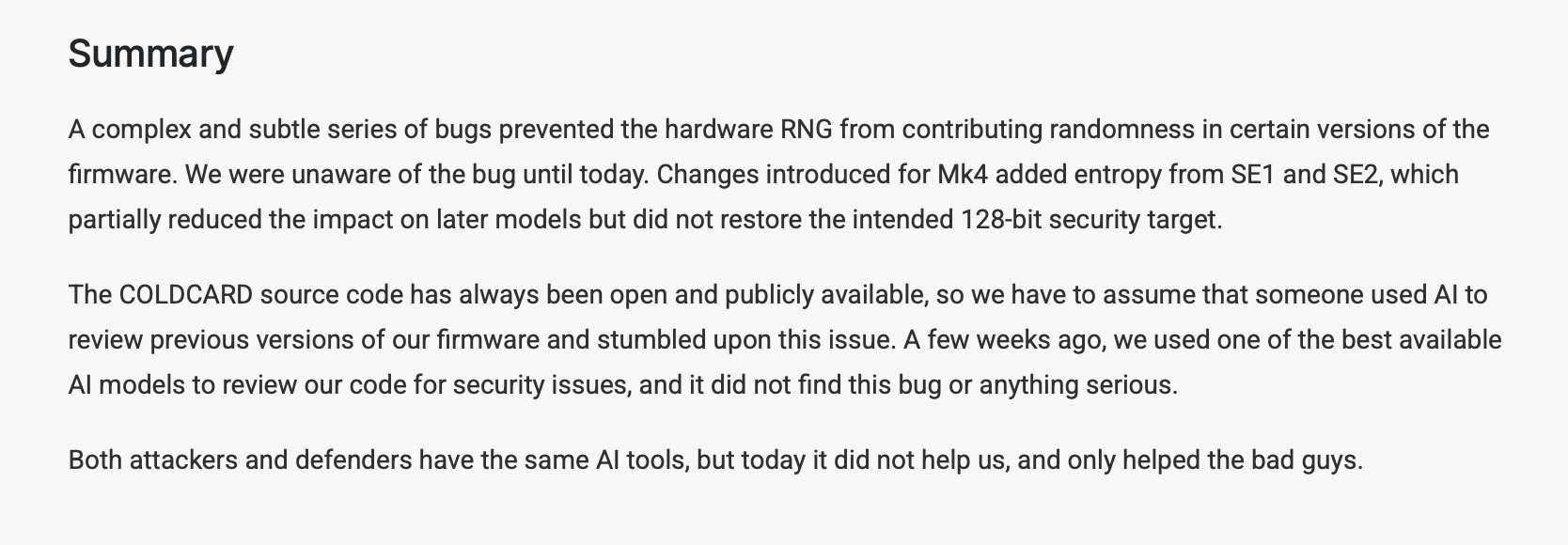
Coinkite acknowledged that its own review using a leading AI model failed to uncover the flaw before the theft. That result shows that AI systems do not automatically find every serious defect. Their performance can depend on the instructions they receive, the amount of code supplied and whether a human reviewer understands the warning signs.
Critics Say the Human Failure Came First
Some security specialists argue that focusing too heavily on artificial intelligence (AI) risks distracting from a basic engineering failure. Many believe the configuration mistake was a known type of software error, and conventional code reviews, testing procedures, or audits centered on seed generation could have detected it years earlier.
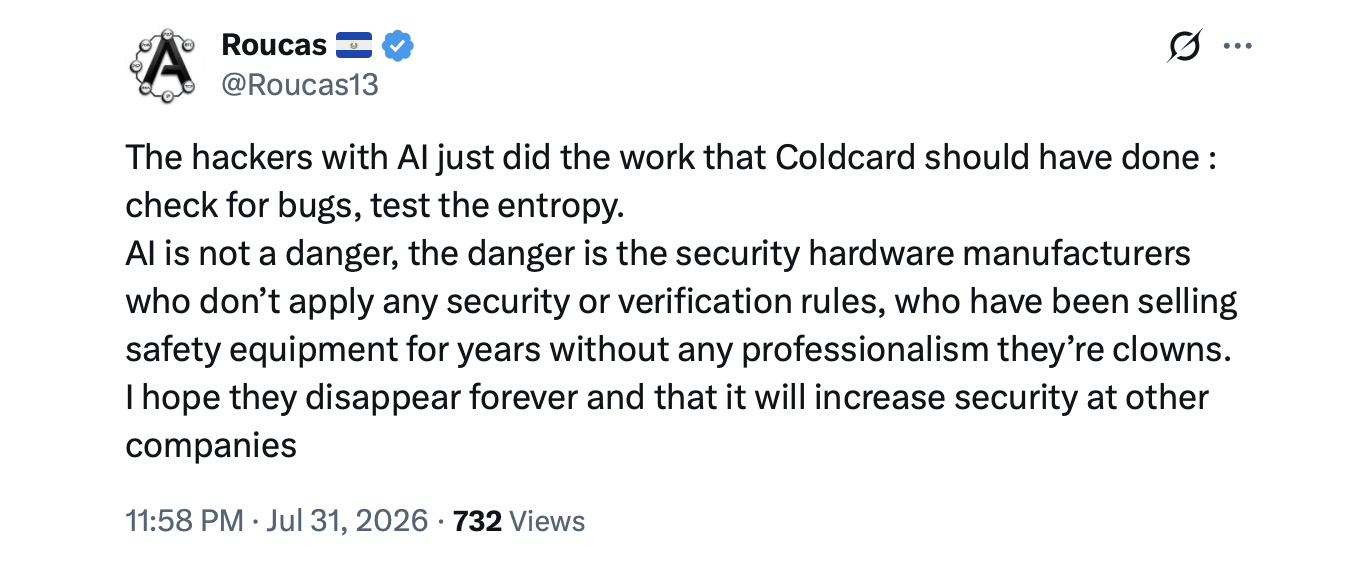
The opposing views are not necessarily incompatible. A human error created the vulnerability and allowed it to persist, while AI may have lowered the cost of finding, understanding, or exploiting it. Defenders must identify every dangerous weakness, while an attacker needs to locate only one.
The incident also challenges assumptions about open-source security. Public code allows independent experts to inspect software, but availability alone does not guarantee that someone will review the correct section, recognize a subtle defect, and report it before an attacker acts.
For Coldcard users, the immediate priority is determining when and how their seed was created. Anyone with an affected seed must verify instructions through official Coinkite channels, install corrected firmware, create a new seed, and move funds carefully while watching for phishing attempts and fake support messages.
The longer-term questions will center on how much bitcoin was taken, whether investigators can identify the attacker, and whether AI played any decisive role in finding the flaw. Hardware wallet companies will also face pressure to strengthen entropy testing, audit build configurations, and continuously examine old code with both human experts and adversarial AI tools.
Originally published by news.bitcoin.com →