AWS Releases AWS Emulator: A Local Copy of 200+ AWS Services Built by AI Agents
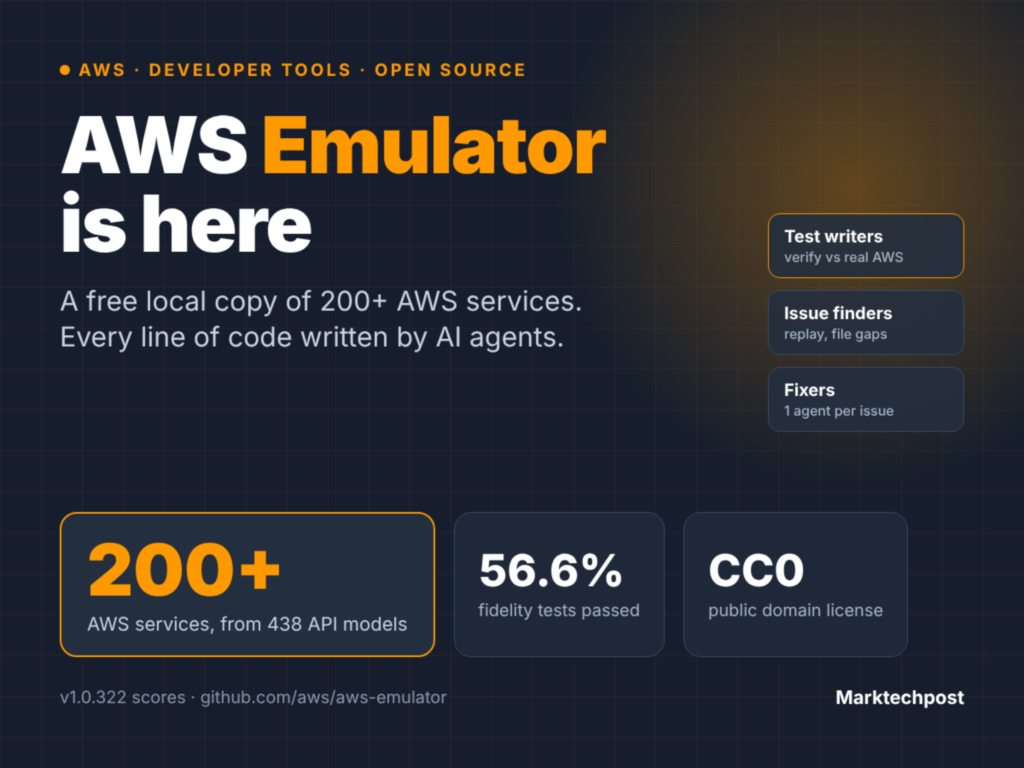
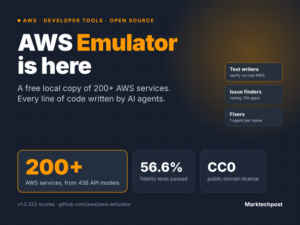
AWS has released AWS Emulator, a local emulator of the AWS APIs. You run it on a laptop, a dev server or in CI. The AWS CLI and SDKs talk to it instead of AWS. No AWS account is needed, and there is no service fee. The unusual part: autonomous agents wrote and reviewed all of its code. For developers and coding agents, AWS Emulator gives a fast, free test loop against AWS-shaped APIs.
What is AWS Emulator?
AWS Emulator is a headless local program from AWS that serves an AWS API endpoint. You point the CLI or an SDK at it with environment variables. Your code does not change. Resources live in memory and vanish when it stops.
The docs show a DynamoDB example. A CreateTable call with a 2-character name fails with the same ValidationException text AWS returns.
How did AI agents build AWS Emulator?
The project began with a prompt to Kiro. It returned a passable Amazon SQS emulator in about 15 minutes. AWS then split the work across 3 teams of agents:
Test writers derive scenarios from the public Smithy API models and verify each against real AWS.
Issue finders replay those tests against the emulator and file failures.
Fixers take 1 issue each and submit a patch.
Every patch passes a merge gate covering build, code review, security and fidelity. Several security agents run adversarial reviews. Matthew Goldberg reports hundreds of concurrent agents fixing thousands of issues a day. The release pipeline runs on AWS Developer Tools, with CodeCommit as the agents’ repository. Code reaches GitHub last.
How accurate is AWS Emulator?
AWS publishes a scores.json file with each release. We tallied the v1.0.322 file, scored on November 11, 2026.
Overall: 24,243 of 42,857 scored tests pass (56.6%); 80 were skipped.
Step level: 49,810 of 68,007 individual steps pass (73.2%).
Cross-service workflows: 2,752 of 6,569 pass (41.9%).
Core services: S3 79.1%, DynamoDB 77.3%, SNS 73.9%, Lambda 46.4%, EC2 41.5%.
Per the fidelity docs, control-plane APIs match AWS best. Data-plane, CloudFormation, Terraform and CDK support varies by service. Unimplemented operations return HTTP 501 NotImplemented. The tests live in aws-emulator-evaluation-suite, including failing ones.
How do you run AWS Emulator?
There are 4 paths, per the README:
Linux: install the RPM or Debian package and run aws-emulator.
macOS/Windows: build a container from AWS’s Dockerfile, capped at 2 GiB memory.
Rust embedded mode: add it as a dev-dependency for 1 isolated instance per test.
Coding agents: aws agent-toolkit add-skill –skill-name aws-emulator, with AWS CLI 2.35.0 or later.
A source build serves HTTPS on 127.0.0.1:9297 with a self-signed certificate. It needs a Rust toolchain, a C compiler and at least 100 GB of disk. Embedded mode carries the same build cost on the first cargo test.
How does it compare with LocalStack, Moto and Floci?
What are AWS Emulator’s limitations?
AWS lists them plainly:
No IAM evaluation. Identity and resource policies are not evaluated like AWS. Do not use it for security tests.
1 Region, 1 account. It accepts any IDs but does not isolate resources by them.
Verified in us-west-2 only, with global services checked in us-east-1.
In-memory and short-lived. It is not tested for long runs or load tests. Use –idle-timeout to stop it.
Telemetry is on by default. Turn it off with –telemetry off, EMULATOR_TELEMETRY=off, config.toml or the embedded API.
The release pace is fast. Versions v1.0.265 to v1.0.322 shipped between November 8 and 11.
Check out the GitHub repo, the user guide, the fidelity tests and the engineering post. Also, feel free to follow us on Twitter and don’t forget to join our 150k+ML SubReddit and Subscribe to our Newsletter. Wait! are you on telegram? now you can join us on telegram as well.
Need to partner with us for promoting your GitHub Repo OR Hugging Face Page OR Product Release OR Webinar etc.? Connect with us
Asif Razzaq is the CEO of Marktechpost AI Media Inc.. As a visionary entrepreneur and engineer, Asif is committed to harnessing the potential of Artificial Intelligence for social good. His most recent endeavor is the launch of an Artificial Intelligence Media Platform, Marktechpost, which stands out for its in-depth coverage of machine learning and deep learning news that is both technically sound and easily understandable by a wide audience. The platform boasts of over 2 million monthly views, illustrating its popularity among audiences.
Originally published by marktechpost.com →