Bitcoin miner Ionic gets 90% of revenue from AI lease as BTC drives $35M loss
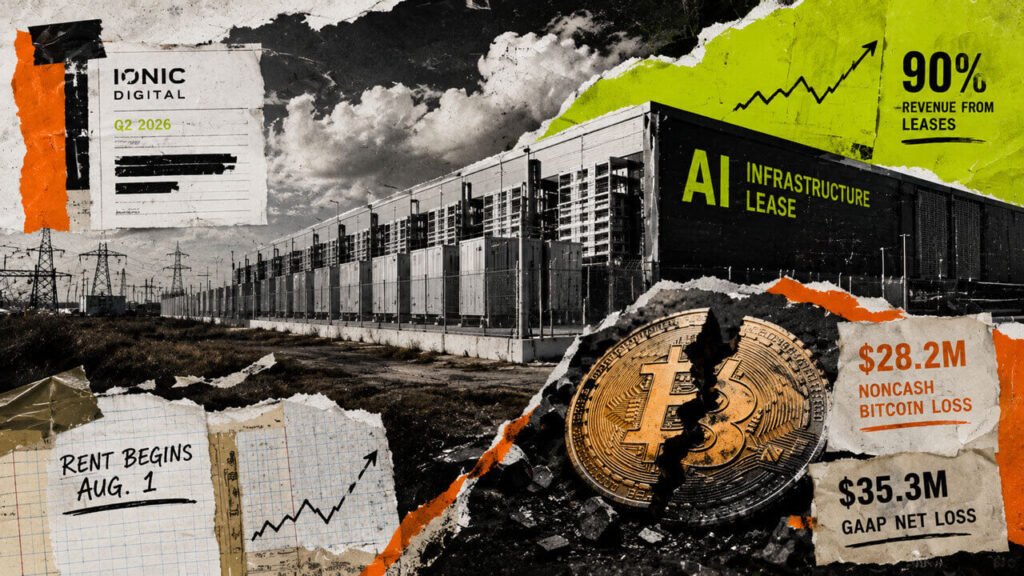
Ionic Digital, a Bitcoin miner repositioning its power sites for AI infrastructure, generated 90% of its second-quarter revenue from leasing. Its Q2 accounts show an uneven transition: operating revenue has shifted away from mining faster than reported earnings have shifted away from Bitcoin.
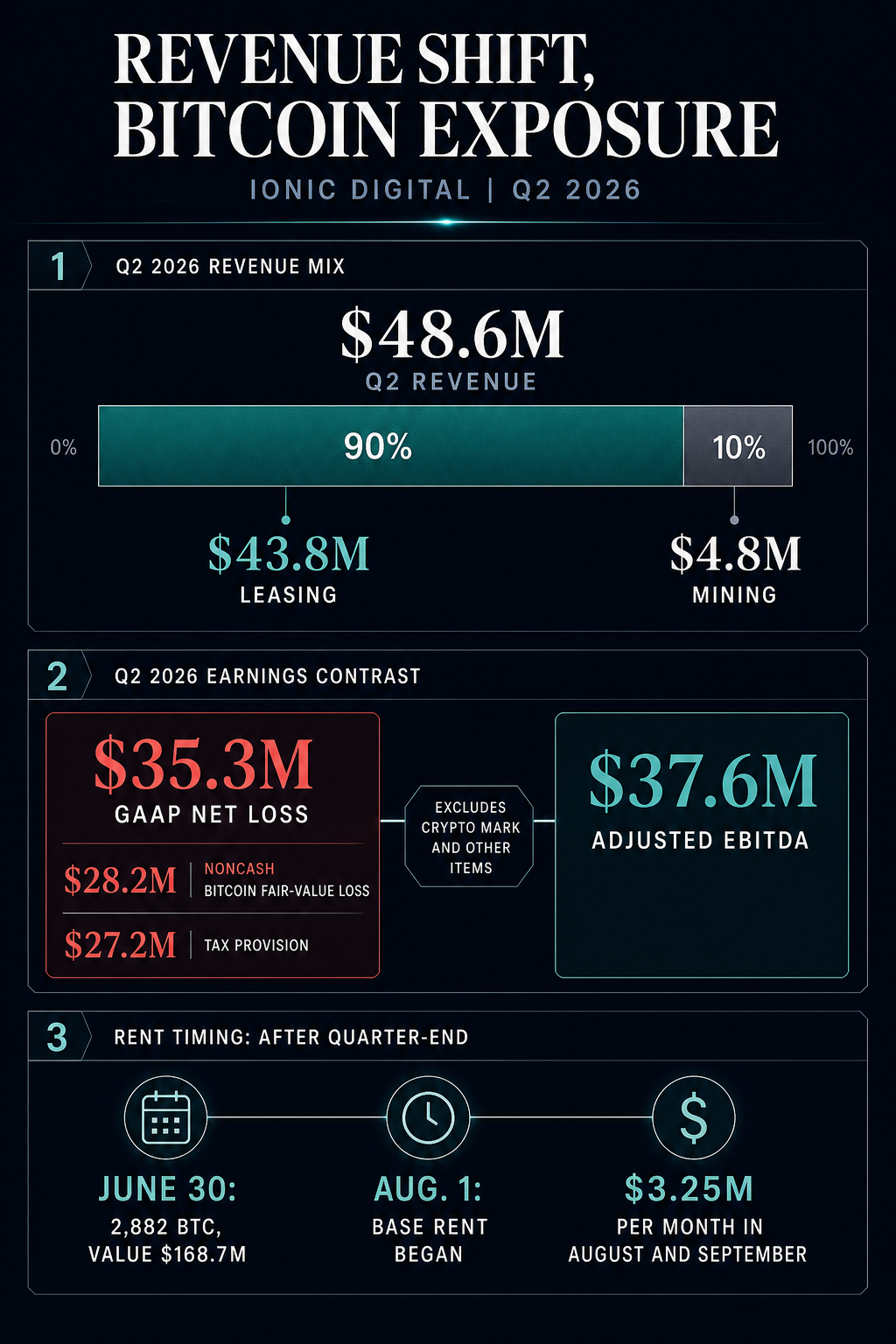
The Ward County lease with AI infrastructure provider Nscale produced $43.8 million of Ionic’s $48.6 million in Q2 revenue, while mining contributed $4.8 million, according to the company’s second-quarter filing. Ionic recognized that lease revenue on a straight-line basis even though recurring base rent began after the quarter, making cash collection the next measure of the shift.
However, Bitcoin still shaped the entire quarter. Ionic recorded a $28.2 million noncash fair value loss on its Bitcoin holdings, contributing to a GAAP net loss of $35.3 million. The charge reflected remeasurement of its holdings. Ionic reported no realized gain or loss from crypto sales and held 2,882 BTC valued at $168.7 million on June 30.
Adjusted EBITDA reached $37.6 million after Ionic’s reconciliation added back the crypto mark, a $27.2 million tax provision, depreciation, stock compensation, and other costs. The company also changed the non-GAAP measure this quarter to exclude realized and unrealized crypto gains and losses and recast prior periods. The measure reflects management’s view of operating performance, while GAAP earnings remain sensitive to Bitcoin prices
Recurring rent starts below lease revenue
Ionic’s registration statement says the Ward County operating lease began Dec. 19, 2025, with revenue recognized on a straight-line basis. Nscale paid a $45.6 million advance payment in November 2025, while scheduled base rent began Aug. 1, after Q2 ended. The advance payment and later rent schedule mean Q2 lease revenue does not directly correspond with cash collected during the quarter.
The lease contract sets monthly payments for the existing 234 megawatts at $3.25 million in August and September, $6.5 million in October and November, and $9.75 million in December and January before reaching the full required-capacity rate. A separate 89-megawatt expansion remained unavailable in Q2; its additional $5.8 million monthly rent begins when Ionic provides that capacity.
The filings show the timing difference without detailing the full Q2 cash-revenue reconciliation. Deferred digital infrastructure leasing revenue fell by $39.8 million during the first half, while current other receivables reached $49.0 million at the end of June without a category breakdown.
Financing accounted for most of Ionic’s increase in cash. The company started the year with $43.5 million, received $400 million in financing proceeds, used $25.9 million in operations and $1.8 million in investing, and ended June with $415.7 million in cash and no outstanding borrowings.
The distinction is important as miners turn power-rich sites into AI infrastructure. Recent miner lease agreements show why reported revenue should be assessed alongside financing and delivery schedules.
Ionic’s operating revenue now depends far less on mining. Its 2,882-BTC treasury keeps reported earnings sensitive to Bitcoin prices, while recurring cash payments from the Ward County lease began after the quarter closed.
Originally published by cryptoslate.com →