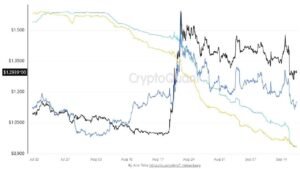
Bitcoin’s 87% Correlation to Global Liquidity Beats Earnings and Headlines

Key Takeaways
Raoul Pal said bitcoin holds an 87% correlation to global liquidity.Pal pegged the Nasdaq’s correlation at 97%, arguing money flow outweighs earnings or news.Pal’s May 2026 thesis targeted $450,000 bitcoin if central bank liquidity expands by year-end.
A Detailed Explanation
Pal, founder of financial media platform Real Vision and a retired Goldman Sachs hedge fund manager, is one of the most closely followed macro voices in crypto who has spent much of the last seven months arguing that liquidity conditions, not fundamentals, drive digital asset prices. Via a post on X, Pal explained:
“Bitcoin is 87% correlated to global liquidity. The Nasdaq is 97% correlated. Which tells you something most people never realise. These assets are not really trading on earnings, or news, or whatever the story of the week is. They’re tracking the amount of money in the system.”
Global liquidity refers to the total pool of money available to flow into financial markets, typically measured through central bank balance sheets, global M2 (broad money supply), and bank credit growth.
Analysts at crypto market maker Keyrock have built an eight-month lag model tracking how Treasury bill issuance percolates into bitcoin returns, a framework that echoes Pal’s correlation claim. The firm’s net liquidity gauge, defined as the Federal Reserve’s balance sheet minus Treasury cash balances and reverse repo balances, is designed to isolate how much spending capacity is actually reaching markets at a given time.

A Familiar Thesis, Refreshed Numbers
Pal’s figures build on a position he laid out in more detail in May, when he told Real Vision viewers that bitcoin maintains roughly 90% correlation with global money supply and argued that governments’ reliance on short-term debt issuance forces central banks to inject liquidity on a recurring cycle.
“Every four years, global debt rolls over, and central banks are forced to pump liquidity to avoid systemic collapse,” Pal said at the time. That thesis underpins his $450,000 bitcoin price target, which he has said depends on central banks expanding liquidity meaningfully before the end of the year.
Nasdaq’s Even Tighter Correlation
The more striking figure in Pal’s post may be the 97% correlation he assigned to the Nasdaq, the tech-heavy U.S. stock index. A correlation that tight would suggest bitcoin and mega-cap tech stocks are now trading as near-identical proxies for the same liquidity conditions, rather than as separate asset classes responding to distinct catalysts. That posturing cuts against the idea that bitcoin trades primarily on its own supply dynamics, halving cycles, or adoption headlines.
Pal is not alone in making that argument, as Strategy Inc. (Nasdaq: MSTR) Executive Chairman Michael Saylor said earlier this month that bitcoin’s traditional four-year, halving-driven cycle is “no longer the dominant model,” pointing instead to ETF inflows, corporate treasury accumulation, sovereign reserves, and global liquidity conditions as the bigger drivers. He added:
Over the next decade, bitcoin’s trajectory will be driven less by miner issuance and more by capital flows.
That said, neither Pal nor the correlation figures in his post come with an underlying dataset or published methodology, and the strength of the bitcoin-liquidity relationship has fluctuated across 2026 as liquidity impulses rose and fell. Keyrock’s own tracking found bitcoin’s reaction to Treasury issuance lags by roughly eight months, meaning any current correlation reading likely reflects liquidity conditions set months earlier rather than in real time.
The next major dealbreaker for the Real Vision founder’s thesis will be whether central banks follow through on the balance sheet expansion he says is required to keep his $450,000 target in play.